


School Visits in SE Asia
- May 17, 2017
- 9 min read
We visited a good variety of schools during our time traveling around Thailand, Cambodia, and Laos. Although we spent hours in some of the schools and only a few minutes in others, we got a sense of the diversity of learning environments and of course, the inequities of school experiences and resources across the selection of schools we visited.
Cambodia
The hotel we stayed at in Cambodia just happened to be right next to a school and in fact, we could see right into the classrooms every time we walked out the front door of our room.

Our view of the school right across from our hotel room in Siem Reap, Cambodia.

As we walked around the neighborhood one afternoon, we happened to see students lining up for end of the day dismissal.


While the students bustled around, lining up and preparing to be dismissed, one of the teachers kindly took a moment to chat with us in English. She informed us that this school has basically two tracks: one for learning in the Khmer language and the other an English immersion program.

Since tourism is the major source of income in this region, and English (as well as Chinese) being one of the most widely spoken languages, this school promotes a path to success through fluency in English.
In our own tourist experience in Siem Reap, we noticed that guides speaking a variety of languages quite fluently. We overheard Cambodian guides speaking Spanish, Russian, and Chinese. However, the language we heard (and used) most frequently here was definitely English, more so than any other place we visited in Southeast Asia.
Thailand


We briefly walked through a couple schools in Bangkok, Thailand that were just down the street from the Buddhist temple, Wat Rakangkositaram Woramahavihan and right along the banks of the Chao Praya River. In fact, the all girls school Satri Wat Rakhang School takes part of it's name from this lovely temple.
We also passed by an elementary school in the same neighborhood and watched young students enjoying some movement exercises outside and making very good use of such small space. The outer gates and fences of both schools were draped in black and white memorial fabric to honor the recent passing of King Bhumibol Adulyadej , as was just about every official building and business in Thailand.
During our week-long visit to Chiang Mai, Thailand, we stayed in the home of a cousin, Nruas Muas, who teaches Hmong and is a prominent local leader in the Hmong Catholic church. In fact, his eldest son was recently ordained as a priest.


Here, Xib Hwb Nruas Muas, proudly shows us his teaching license. Not only did he provide us with a place to stay in Chiang Mai, he also generously gave up 2 weeks of his time to drive us all over sightseeing in the area, visiting local schools, and was our guide into Laos as well. We learned so much from this man over the course of hours of conversation during our long rides in his truck!

The first school he took us to was a Catholic boarding school in Chiang Mai where we had a chance to chat with students after their long day of learning.

Although it was late in the afternoon when we arrived and most of the children were out playing in the school yard, they reassembled in their main room to meet us. Xib Hwb Nruas got them singing and moving about since they'd already had a full day of lessons. While some of the students speak Hmong, their lessons are all in Thai so conversation was a bit of a challenge since we might say something in Hmong and then Xib Hwb Nruas would translate into Thai and then back again into Hmong or English so we could understand their responses.

As we talked with the students, a couple dogs randomly wandered in and out of the meeting room.
He tried to get the students to sing a simple Hmong song, call and response style, but they were definitely more engaged when he switched to the Thai song they all knew since that is the language they have in common.

One of the most precious moments, for me, during this visit was when Xib Hwb Nruas shared the small school photos of my two sons with the students. I carried these in my phone case during our entire trip so that my boys would always be with me wherever we went and so that I would always have photos to share with the people we visited. The kids all crowded around, trying to see the small images, and asking us questions about the boys. I thought about how different their life and school experiences are and the fact that some of these children are the same ages as my boys. Being with these children made me miss my own two boys even more, as well as my students at Lincoln Elementary.

The students at this particular school represent a variety of local ethnic groups such as Karen, Hmong, Lisu, Yau, and Akha. While the ethnicities and languages are diverse, the students at this school share in common both the dominant Thai language as well as the experience of being orphans. Some have been orphans since birth and others were given up when their parents could no longer support them for a variety of reasons.

After the whole group session, a few of the Hmong students sat down to chat with us (although a lot of the conversation was still in Thai). Since Txi and I do not speak Thai, our communication was limited, and since we had an engagement scheduled afterwards, our time was limited as well.


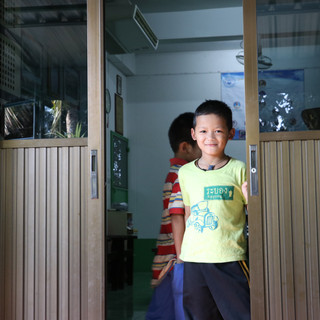
In spite of these limitations, the students held our hands, smiled warmly, waved, and sadly watched us leave. It was emotionally difficult (for everyone involved, not just us) to simply drop in one day, make a connection, and then drop out. While we treasure the experience and although we left contact information, we are, at the same time, aware of the part we play as outsiders, potentially adding to the instability of these children's lives. It's not a good feeling, but then again, getting outside of one's comfort zone is a huge part of personal growth. I only wish we could have offered them something more, at least more of our time.

The last school we visited in Thailand was definitely my favorite school experience of the entire trip. Xib Hwb Nruas took us up into the mountains near Chiang Mai to visit Chao Pho Luang Upatham School, which is right in the center of a Hmong village.
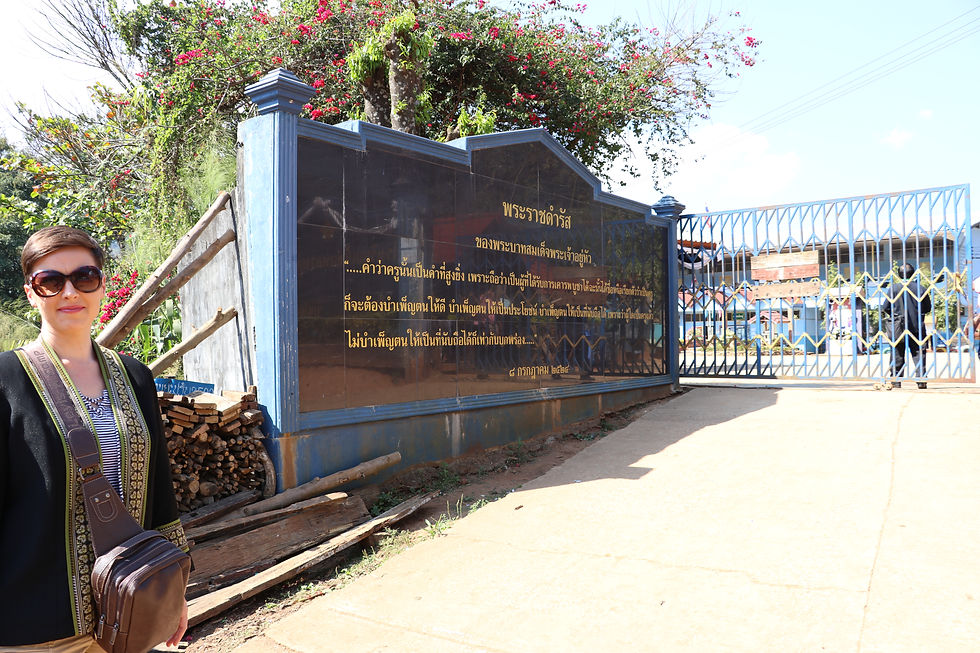
The outer gates of the school, which is part of the former King Bhumibol Adulyadej's initiative to provide education for all the peoples of Thailand.

Their school banner, Chao Pho Luang Upatham School.

One of several buildings that form the complex of this school. On the second foor of this building is where we spent most of our time, visiting classrooms.

This is the main teacher of the 5th grade classroom where we spent most of our time during our visit. Although he is Hmong, he teaches predominantly in Thai.

We came in during a math lesson (this is one of the workbooks a student was using), just before the transition to recess or Hmong language class.

Xib Hwb Nruas visits this school regularly on Fridays to specifically teach Hmong language lessons for about an hour each week. Although students typically wear uniforms to school, on Fridays they are encouraged to wear their Hmong clothes to promote a strong sense of cultural pride and personal identity. The couple of boys in the class who did not wear Hmong clothes are actually not Hmong although they regularly attend the Hmong class.


Students proudly wearing Hmong clothes at Chao Pho Luang Upatham School in Chiang Mai.

After introducing us to the class, Xib Hwb Nruas got right into the Hmong lesson focused on pronouncing alphabet letters/words using the well known Hmong primer book developed by Yves Bertrais, one of the founders of the Hmong RPA system of writing in the 1950s. This primer has been in use for several generations now and is recognized by many of the literate Hmong elders as a primary tool for teaching the language.

The students go through each letter of the alphabet, practicing it's pronunciation with each of the 8 tones and as a part of various high frequency words.
This video shows how difficult it was to concentrate on the lesson while the majority of the school had recess time outside in the courtyard. Although it was very distracting, the students have chosen to participate in this class and were, under the circumstances, very attentive. In addition to the typical exercises, Xib Hwb Nruas incorporates a simple song to help practice the alphabet letters/tones/pronunciation.

Eventually though, one of the boys succumbed to the pull of outdoor recess, leaving his Hmong jacket inside and joining his friends outside for a bit of play time together before the end of the school day. This is a struggle I can really relate to, since the Hmong club I teach is also during recess time, although it's only 30 minutes, compared to the hour given at this school. While I don't necessarily like the idea of trading valuable free play time for more in class learning, there are very few options for incorporating heritage language programs into classrooms during the school day. This, at least, offers students a rare oppotunity to learn Hmong literacy as a part of the school day, even if it is just one hour a week.

I also noticed that many of the students had similar struggles with pronouncing certain letters of the Hmong alphabet that are also tricky for my own Hmong American students. Here, Xib Hwb Nruas specifically focuses on distinguishing the difficult 'r' versus 'ts' consonant sounds.







Scenes from the recess going on outside the classroom. Lots of different activities going on!


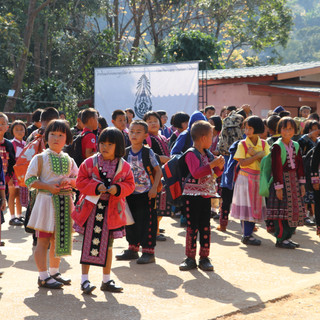


Scenes from the end of the day as students line up, sing the Thai national anthem, and then head back home for the day.

School girls on their way back home after school.
Laos
The first village we visited was Nam Phet, in Bokeo Province which is in the northern part of Laos, the smallest and least populated province in the country. This is the village where Niam (my mother-in-law) lived for about 20 years. It is where she grew up, married Txiv (my father-in law), and where they began raising a family.

This is the village school that Txiv helped to build over 50 years ago.

While the outer thatch has been repaired and replaced many times since then, the basic framework remains the same as it was when Txiv first helped to build it.

This is one of three classrooms where students sit on benches at rough hewn tables on dirt floors. This was our first stop when we entered the village and we were informed by some of the villagers that classes had been cancelled for some reason that day.

The next day when we visited the school, the teacher was leading multiple lessons simultaneously, trying to move between two full classrooms of students. Students were divided between the two rooms by age (basically, a room of K-2 age students and a room of 3-5 grade students), with about 30 children in each room. Seems like a logistical nightmare, but the students were handling it fairly well. Kids are so amazingly adaptable...

The students on the K-2 side waited patiently (although they were understandably restless), while the teacher led a lesson in the 3-5 grade classroom. The Laotian teacher, although he was teaching Lao, admitted that he had to learn and use at least a little bit of Hmong language so that the students could follow the lesson. He and I communicated in broken Hmong since I don't know Lao, except for the Lao words that have been adopted into the Hmong language.
This was part of the K-2 numbers lesson going on when we arrived. The style of teaching in all of the classrooms we spent time in, reflects a more traditional, rote learning through recitations/copying information, which is a pretty stark contrast to the school culture I'm used to in Madison, WI.





While it was noisy and there were lots of people wandering in and out of the classrooms, the students, for the most part, remained focused on their math lessons.

Our buddy (and distant cousin), Maesai Kong, hanging around the doorway of the 3-5 grade classroom. He is too old to attend school here anymore and the nearest school for his age level is miles away. He said his parents don't let him go because it's too far, so he helps them farm instead. We could tell he really missed being in school as he hung around the doorway and played with the little ones in the preschool room.
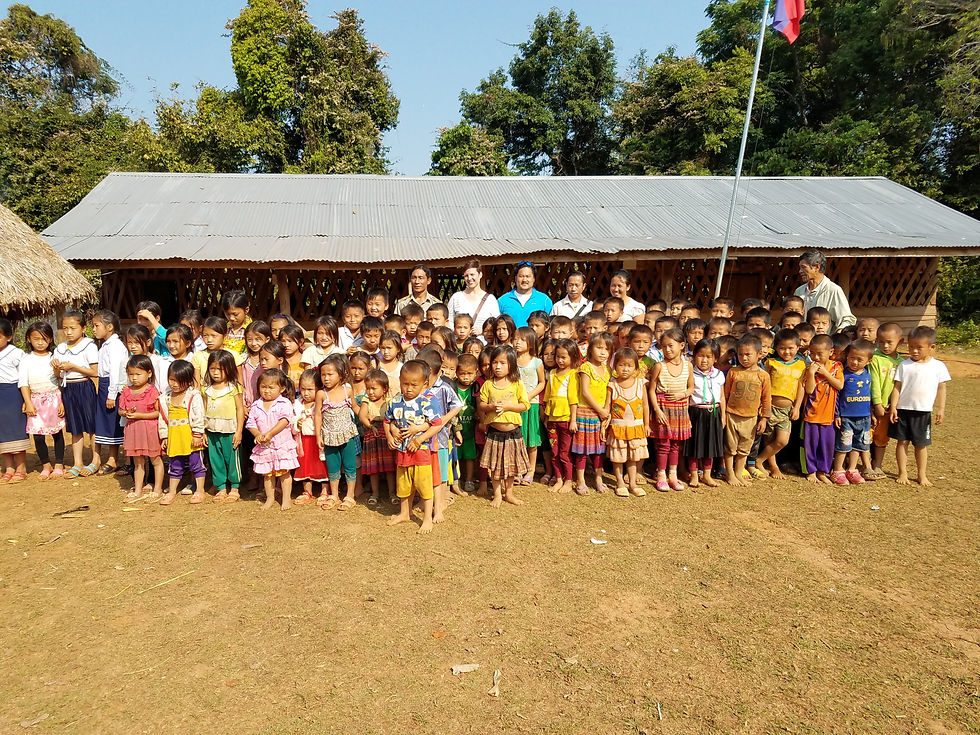
After their lessons, the kids were assembled and lined up outside (with the help of some other adults from the village), for a school photo and short presentation with words from their teacher, Xib Hwb Nruas, and me.

We presented them with a truckload of donated clothing from the Catholic diocese in Chiang Khong, Thailand, which we picked up on our way to Laos.


As much as I dislike speaking in front of large groups, the school kids with their shy smiles and curious eyes, made me want to stay...

Txi and I with the current village leader and his wife. Shortly after this photo, while the kids were all standing around not quite sure of what they should do next, waiting for their teacher's directions, Txi challenged them all to a race across the open field in front of the school and promptly took off running.
Most of the kids were shocked by his child-like behavior, and they laughed (as did many of the adults watching the scene) as they tried to catch up with him. It was a great release of energy for the kids who had been sitting through lessons and then lined up for some long-winded speeches in an assembly out in the hot sun. It was a great end to our school visit experiences in SE Asia.

Of course, visiting a village school like this and realizing the overwhelming lack of resources, makes you immediately want to start up a donation website for the village. Luckily, there are few good sites that I have found created for this specific purpose.
For information on how to help villages like this one in Laos, check out:
www.bigbrothermouse.com
www.globalgiving.org/projects/books-libraries-literacy-for-school-children-in-laos/
https://adoptavillageinlaos.wordpress.com/
Comments