


HLL
- Jun 4, 2017
- 8 min read
Kuv yog ib tug 'HLL'. I am a Hmong language learner. Although I generally try to avoid the restrictions of categories and labels, this is how I would identify myself. Proud of my own Irish-Italian heritage, passionate about exploring world cultures, and focused on learning and sharing as much as I can about Hmong culture in particular. Being one of the world languages at high risk of extinction lends an urgency to this pursuit as well as a desire to be a part of preservation and revitalization efforts.

The first time I felt this acute urgency was during my college years at the University of Wisconsin-Madison. At the time, I worked for the Madison Public Library and often listened to NPR programs while I shelved books. I distinctly remember a particular program called, "Lost and Found Sound" which on one occasion played a recording some explorer made centuries ago of a mother singing a lullaby to her baby in an African language that no longer exists. Listening to the haunting sounds, I remember being moved tears and it struck me that the Hmong language could share this same fate one day.

The origins of my journey into Hmong language and culture begin with Niam, my mother-in-law. It was my desire to communicate more meaningfully with her, that drove my first forays into the Hmong language. Niam speaks English too, but she is much more comfortable in Hmong and communicates most fluently in that language. I owe a great deal to Niam for taking the time to teach me so many aspects of Hmong culture, especially cooking, and for her patience when I mess(ed) things up. She, and other members of my Kong family, taught me Hmong words here and there, but being a visual learner and a slow processor, I needed a more concrete method, so in college I enrolled in the Southeast Asian Summer Institute's Hmong program. An intensive all day summer program, I learned from some of the best teachers. Most of the literacy in Hmong that I have retained to this day, stems from my learning with Xib Hwb Tooj Pov Vaj. Whatever good Hmong literacy skills I have, I owe to him (and whatever bad habits I may have developed, I blame my husband! Just kidding, I own it.)

In my earliest days of teaching, my Hmong students were delighted to discover that I could speak, read, and write Hmong and although my Hmong fluency is quite basic, I am always happy to share what little I know, for whatever it's worth, but the greatest joy comes from making deeper connections to my students and colleagues. The more I explore and connect with others, the more I learn and realize how much more there is to learn. This ongoing cycle has been an integral part of the evolution of "Hmong Club" at Lincoln. When a small group of my Hmong students asked to stay in for recess to practice sewing paj ntaub with me, I brought in the supplies and sewing samples I had received from my sisters-in-law and we spent one recess a week sewing and talking about all kinds of things. This once a week sewing circle developed, over the last 12 years, into an after school program and then evolved into an enrichment club during the school day for both Hmong and non-Hmong students interested in learning about Hmong culture.


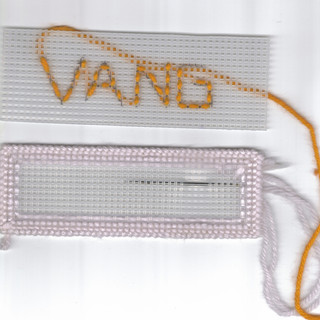
These are some early sewing samples from the very first Hmong Club starting with my own sewing sample (on the left), an advanced student working from my sister in law's sample (middle), and then a basic beginner sample (right).


As our sewing circle expanded into an after school program, we incorporated art projects, games, and foods into our explorations of Hmong culture. I also began recruiting local Hmong college students to help out with the club, serving as role models for the kids and lending a critical native speaker's voice to our learning.


Some of our favorite games for practicing Hmong literacy skills include: Hmoob Bingo, charades, pictionary, and "Ib daim" (Uno, played in Hmong). We also began a tradition of annual field trips, starting with the Hmong at Heart Exhibit at the Madison Children's Museum. Up to this point, our field trips have included visiting our local Hmong grocery store, East and West High School's annual Hmong New Year celebration, local Hmong community center for elders (Kaj Siab House), and the Hmong American Peace Academy in Milwaukee for their annual Hmong spelling/word bee.
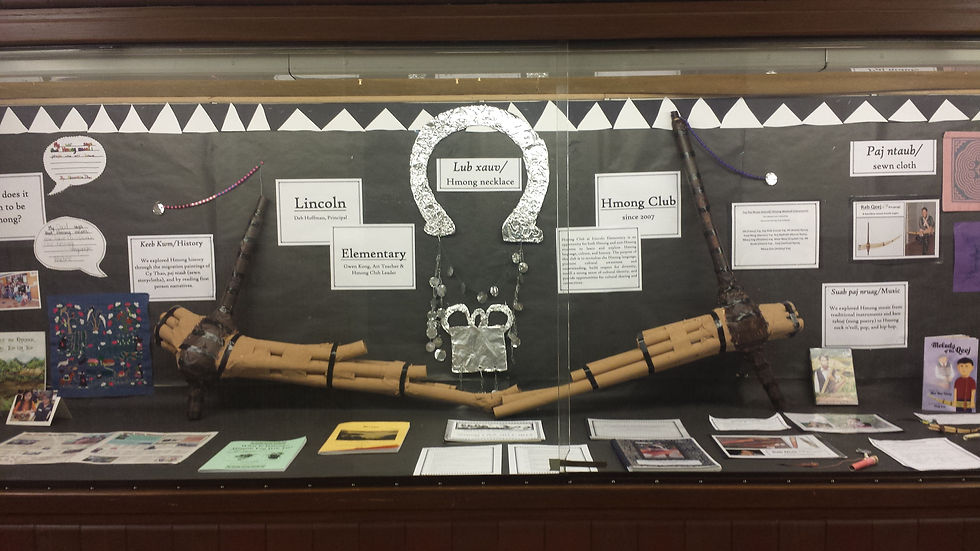
Each year I strive to improve the Hmong Club learning time at Lincoln, working towards expanding my own literacy (including modeling perseverance through that struggle), revitalizing language and literacy with my students, and hopefully inspiring them to explore and share their home culture in new ways. In the last 4 years, we expanded the club to include non-Hmong students as well. We currently have 3 different levels of Hmong club at Lincoln: Beginner (for Hmong and non-Hmong students), Intermediate (for non-Hmong students who have already participated in Beginner Hmong Club), and Advanced (for Hmong students only, regardless of their fluency level).

Intermediate and Advanced Hmong Club students worked together to build a Hmong village model out of recycle materials, clay, paint, and papier mache to share with others what they learned about Hmong village life in Laos.

Advanced and 3rd year Intermediate Hmong Club students learning about the 2 string violin instrument from a master musician at Kaj Siab House in Madison WI.

Some of our Advanced Hmong club students wearing their Hmong club t-shirts "ninja style" on the way to Kaj Siab House field trip.

Hmong club visiting Kaj Siab House and taking a tour of a traditional Hmong house.
In addition to the Hmong club lessons, and of course, integrating Hmong culture into my own classroom lessons, I began leading workshops in classrooms where teachers were interested in exploring Hmong history, language, and culture and incorporating this into their classroom curriculum. These workshops have provided so many opportunities for increasing cultural awareness as well as cultural exchange, also offering Hmong students the chance to share home culture and take on leadership roles in their classrooms.

Classroom workshop on Hmong history and language through paj ntaub symbols at Orchard Ridge Elementary.
Taking a sabbatical leave to reflect on this work and envision new directions for the future, I realized that part of the journey must be to challenge myself in new ways so that I can improve my own practice.
Having the opportunity to immerse myself in Hmong language and culture by traveling to Laos and Thailand with Niam and Txi, and taking the time away from the classroom to reflect on my teaching and goals, has offered me a whole new perspective and given me a renewed energy for this important work. Spending days on end entirely in Hmong and staying in Hmong villages with relatives made me realize how much more there is yet for me to learn and just how complex literacy can be.

For example, Niam loves to explore Facebook and connect with relatives and friends through it, but she does not read or write (only minimally in English or Hmong). So, it was a lot of fun to read captions and headlines for her in Hmong so that she could understand and even better than that, she would say, "Nyab, kuv xav koj sau rau kuv..." and I would write comments for her. It was a great joy to be able to transcribe her perfectly pronounced Hmong (much easier for me to understand since I am so used to her way of speaking, cadence, and vocabulary) and help her engage with friends and family members in a new way. We shared a lot of laughs, stories, and connected through these exchanges.

As we traveled into Laos, spending 6 to 8 hours in a small truck with 4 fluent Hmong speakers was an invaluable experience. For the first couple hours, I would actively try to participate in the conversation although to be honest, I'm not a great conversationalist (even in English). I much prefer to express myself non-verbally through writing and art, which is no surprise. What was surprising to me was the level of mental exhaustion that I reached after about 4 or 5 hours of constant conversation. It became so difficult for me to keep up with the conversation that eventually I would just give up and sort of shut down. It dawned on me afterward that I have seen Niam do the same thing at family gatherings when the younger generation drives the conversation from Hmong to Hmonglish to English. She gets more quiet and reserved as a purely English conversation wears on and eventually just checks out entirely. It's not that she doesn't understand English, it's just that it is so much work for her mentally to translate, comprehend, and then create a response, that it becomes exhausting.
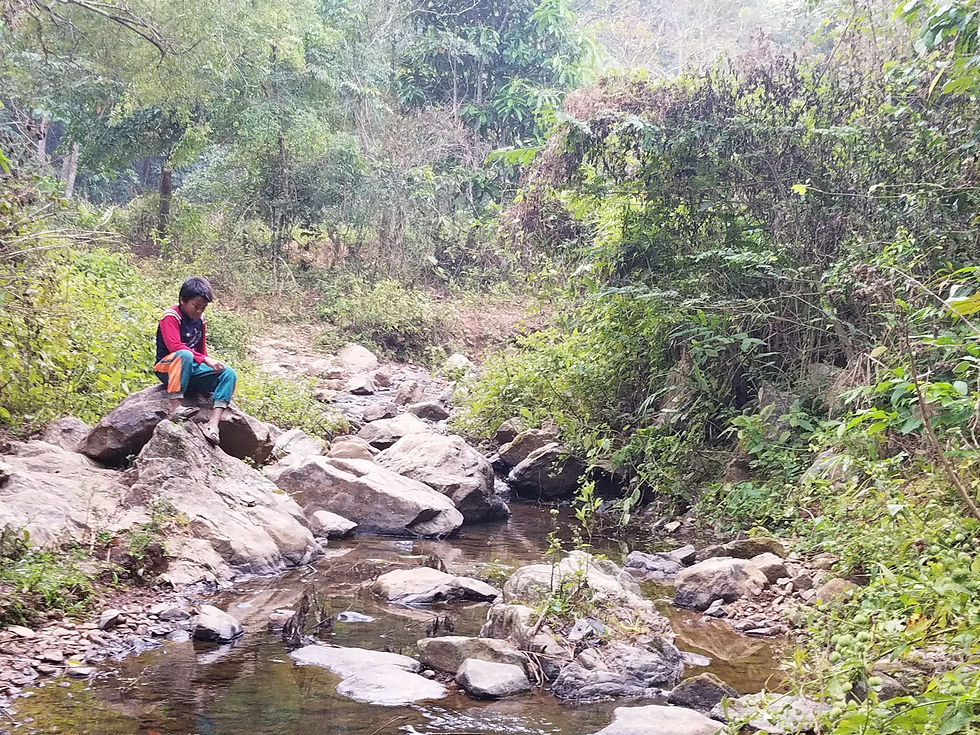
A visual came to my mind as I wrote in my journal and attempted to illustrate my feelings about my immersion experience in Laos. I felt like I was standing in stream of Hmong conversation. When the conversation flowed slowly, I was able to catch words like slow moving fish in the stream, even sharing when I could catch enough. When the current of conversation moved quickly and there were multiple streams (speakers) converging at the same time, often with muddy waters (words in Lao or Thai mixed with Hmong), I was not able to catch as many fish (words) and after hours would feel like I was starting to drown. Once in a while, Txi would throw me a line and get me back into the conversation, but I was mostly on my own. This experience allowed me the opportunity to get a sense of what so many English language learners experience in the U.S. feel on a daily basis. I imagined how some of my students who are so fluent in a first language other than English, must feel during a long school day of constant linguistic challenges.
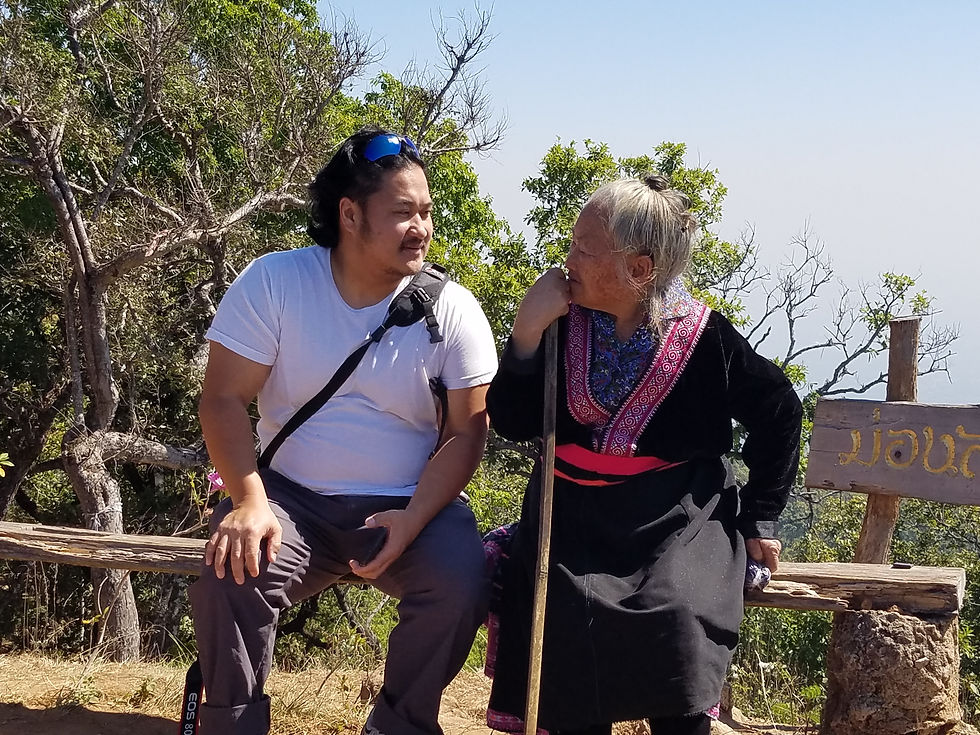
I was proud of my husband for keeping himself immersed in Hmong for the vast majority of our trip. Although Hmong is his first language, he has spent the majority of his life since elementary school in English. Even though he apologized in all the villages for his childish level of Hmong, he didn't let that stop him from having meaningful conversations with everyone around him and as the trip wore on, his fluency, confidence, and vocabulary, increased. He's more outgoing and has way less shame than I have in general, so this is not really a surprise either, but I was grateful that he could carry the conversation while I observed, listened, learned, and tried to soak in everything that I could, participating in my own way.

So, in reflecting on this trip in terms of Hmong literacy, I return to where I started. I am a Hmong language learner and always will be. It is a struggle and a passion and a joy that I will continue to share with my family and students. I continue to be inspired by Niam and she is still the person I enjoy speaking Hmong with the most, although I know I need to speak more with her and that remains a goal that I work towards. As I work on improving my own literacy and fluency, I hope to inspire my students and my own children to pursue their literacy goals and find a sense of pride in cultural identity. There is definitely beauty in the struggle.

Comments